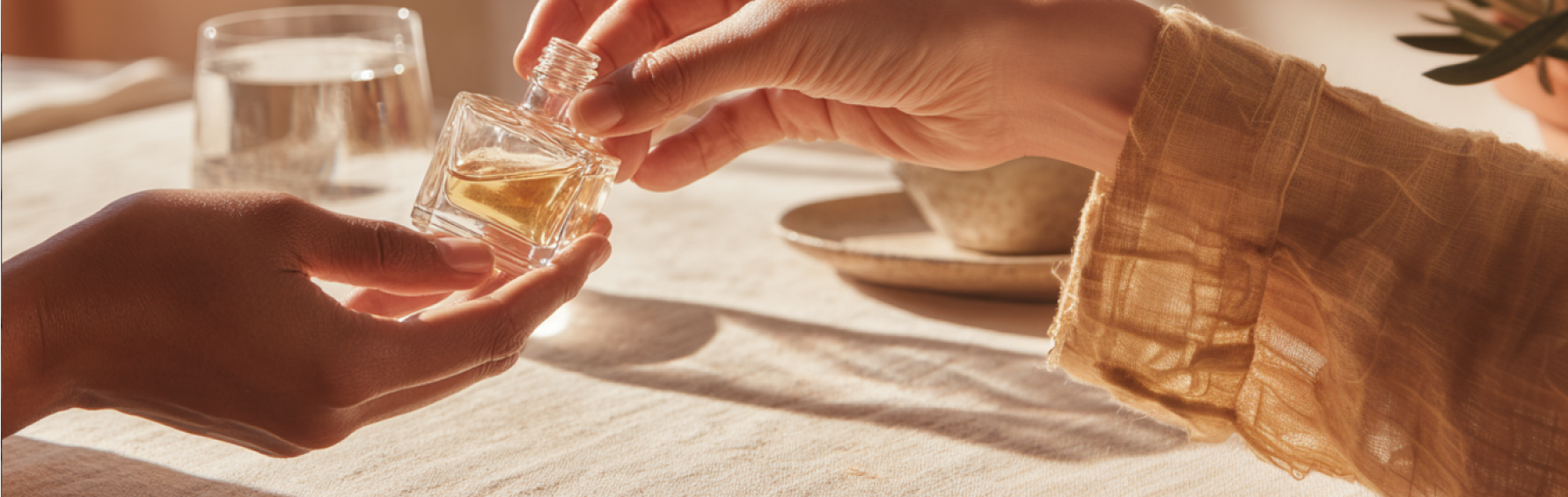
The courier arrives, you spray the submission on a blotter, and your heart sinks. It is sharp. There is an alcoholic bite across the top that was not in the brief, and the beautiful base you were promised is somewhere underneath, muffled. The instinct is to send it back and ask for a rework.
More often than not, the fragrance is fine. It simply has not rested yet. Maceration is the least discussed and most misunderstood stage in fragrance production, and misreading it costs brands weeks of unnecessary reformulation. Here is what it is, how long it takes, and how to build it into a launch plan.
What maceration actually is
Once a perfumer’s formula is compounded, the resulting fragrance concentrate is blended into its carrier, usually perfumer’s alcohol for a fine fragrance, or an oil base for an attar or mukhallat. Maceration is the controlled period the blend is held for after that, before it is filtered and filled.
It is not idle time and it is not a scheduling buffer. It is a production step with a defined duration, and skipping it produces a measurably different product in the bottle.
A fragrance evaluated on the day it was blended is not the fragrance your customer will smell. If you are judging a submission, the first question is not “do I like it” but “when was this compounded”.
What changes while the fragrance rests
Three things happen over the rest period, and together they account for the difference between a fresh blend and a finished one.
- The alcohol integrates. Freshly blended, ethanol dominates the opening and reads as a hard, spirituous edge. As the blend settles, that edge recedes and stops competing with the top notes.
- The materials fully dissolve and distribute. Heavier materials, particularly resins, balsams, woods and musks, need time to disperse evenly through the carrier rather than sitting as a separate layer.
- The composition reads as one thing. This is the part perfumers care about most. Before maceration you tend to smell a set of ingredients in sequence. Afterwards you smell a fragrance, with the transition from top to heart to base running smoothly rather than in steps.
Brands frequently describe a rested fragrance as lasting longer. Whether the measurable evaporation profile has genuinely changed is a matter for the evaluation lab, but the perceived improvement is consistent enough that no serious house evaluates a submission on day one.
Maceration, maturation and chill filtration
Three terms get used interchangeably in online discussions and they are not the same thing.
| Term | What it refers to |
|---|---|
| Maturation | The fragrance concentrate resting on its own, before it is diluted into a carrier. Not every composition needs it. |
| Maceration | The diluted blend, concentrate plus carrier, resting under controlled conditions. This is the stage this article is about. |
| Chill filtration | Cooling the rested blend and filtering it, so that waxes and insoluble material drop out and the liquid stays clear in the bottle. It happens after maceration, not instead of it. |
None of these is the same as a fragrance degrading. A well-made fragrance stored properly improves over the rest period and then holds. Degradation is a separate issue, driven mostly by heat, light and oxygen after filling.
How long it takes, by composition
There is no universal number, which is why the internet argues about it. The rest a composition needs is driven by what is in it and how concentrated it is. As a broad orientation:
| Composition | Indicative rest before evaluation |
|---|---|
| Light citrus, aromatic or fougère, lower concentration | Around one to two weeks |
| Floral and fruity-floral | Around two to four weeks |
| Woody, amber and oriental compositions with resins | Around four to six weeks |
| Oud, heavy mukhallat and high-concentration attar-style blends | Six weeks and upwards |
Indicative ranges only. The protocol for any given formulation is set by the house that made it, and should be confirmed rather than assumed.
The pattern is worth internalising: the heavier and richer the composition, the longer it needs. This is exactly why Middle Eastern compositions built on oud, resins and animalic materials sit at the far end of the range, and why a crisp summer eau de toilette can be assessed relatively quickly. Our work in Middle Eastern fragrances is built around compositions in that heavier register.
What lengthens or shortens the rest
- Concentration. A parfum at 25 per cent needs longer than an eau de toilette at 8 per cent. More material, more integration.
- The material set. Resins, balsams, oud, animalic notes and heavy musks extend it. Citrus and light synthetics shorten it.
- The carrier. Ethanol grade and water content change the picture. An oil-based attar macerates differently again, and generally more slowly.
- Temperature and light. Rest happens in the dark, at a stable, controlled temperature. Heat does not usefully accelerate it, and swings work against consistency.
- Agitation. Gentle, controlled movement helps distribution. Vigorous shaking does not help and can introduce air.
Why production maceration is not the same as waiting
The hobbyist version of maceration is: blend it, put the bottle in a dark cupboard, wait a month, shake it now and then. That is genuinely how it works at small scale, and there is nothing wrong with it.
At production scale the objective is different. It is not enough for this batch to smell good. The tenth batch has to smell like the first, which is only possible if maceration is a controlled and documented parameter rather than a period of waiting. In practice that means defined hold times per formulation, temperature-controlled tanks, records against each batch, then chill and polish filtration to a defined specification before filling.
It also means keeping rested reference samples. A retained control that has been through the full process is the only fair comparison for a future batch, and it is the difference between being able to answer a customer complaint about drift and having to guess. If you want the surrounding stages, our guide to the perfume manufacturing process sets out where maceration sits in the whole sequence.
Planning a launch and unsure how much time to allow?
Tell us the composition and the concentration you are aiming at, and we will give you a realistic development and maceration timeline before you commit to a launch date.
What this means for your launch timeline
Four practical consequences, all of which are cheap to plan for and expensive to discover late.
- Do not evaluate on arrival. Ask when the submission was compounded. If it was blended three days ago, you are smelling an unfinished product and any feedback you give is feedback on the alcohol.
- Compare like with like. If you are choosing between two submissions, make sure both have had comparable rest. Otherwise you are running a blind test with one variable you did not control.
- Put maceration on the critical path, not in the buffer. For a heavier composition it can be six weeks or more, and it cannot be compressed by pushing. It sits between approval and filling, and it has to be in the plan alongside packaging lead times.
- Re-taste before you sign off production. The approval sample and the production batch should both be assessed rested. Approving a rested sample and then filling an unrested batch is how a launch ends up with a product that does not match what was signed off.
Five questions to ask your manufacturer
These take a minute to ask and tell you a lot about how a house actually runs.
- When was this batch compounded, and how long has it rested?
- What maceration protocol do you use for a composition like this one?
- Is maceration time recorded as a production parameter against each batch?
- Do you chill filter, and to what specification?
- Do you keep rested reference retains, and can we compare a future batch against one?
A partner who can answer all five without hesitation is running a controlled process. One who cannot is likely treating maceration as waiting, which is the most common root cause of batch-to-batch drift. That control is the substance behind our private label and white label manufacturing work, and it is documented in the standards our facility and certifications are built around.
The short version
- Maceration is the controlled rest a blended fragrance needs before it is filtered and filled.
- A fresh blend smells harsh because the alcohol has not yet integrated. That is not a fault in the formula.
- Roughly one to two weeks for a light composition, six weeks or more for oud and heavy orientals.
- At production scale it is a documented parameter, because batch consistency depends on it.
- Never evaluate a submission on arrival, and never compare two submissions of different ages.
Frequently asked questions
How long should a perfume macerate?
It depends on the composition and the concentration. As a broad orientation, one to two weeks for a light citrus or aromatic at lower concentration, two to four weeks for florals, four to six weeks for woody and amber compositions, and six weeks or more for oud and heavy mukhallat blends. The protocol for a specific formulation should come from the house that made it.
Can maceration be speeded up?
Not meaningfully, and not without risk. Heat is the usual suggestion, and it tends to cost more in stability and consistency than it saves in time. At production scale the aim is a repeatable process, so the practical answer is to plan the time in rather than try to compress it.
Does maceration make a fragrance last longer on skin?
Users consistently report better longevity from a rested fragrance. What is certain is that the composition reads as an integrated whole rather than a sequence of separate materials, and the harsh alcoholic opening that masks the early notes has settled. Whether the underlying evaporation curve has genuinely changed is a question for the evaluation lab rather than a claim worth making on a label.
Is this the same as a bottle improving at home over time?
They are related but not the same. Maceration is a controlled production stage carried out before filtration and filling. A sealed, filled bottle stored in a cool dark place will continue to settle a little, but it has already been through the process. Storing a bottle in sunlight or heat does the opposite and degrades it.
Should I reject a submission that smells harsh when it arrives?
Not before you know how old it is. Ask when it was compounded. If it is only days old, let it rest and re-evaluate before giving feedback. If it has been properly rested and still does not match the brief, that is genuine feedback and worth giving in detail.
Want a timeline you can actually plan against?
Development, maceration, filling and packaging all have real durations, and a launch date set without them is a launch date that slips. Tell us the composition, the concentration and the volume, and we will give you the honest version.
Sawai Fragrances is a three-generation Indian fragrance house with in-house perfumery, owned natural-ingredient supply and certified manufacturing under one roof, working with brands from first brief to repeat production.