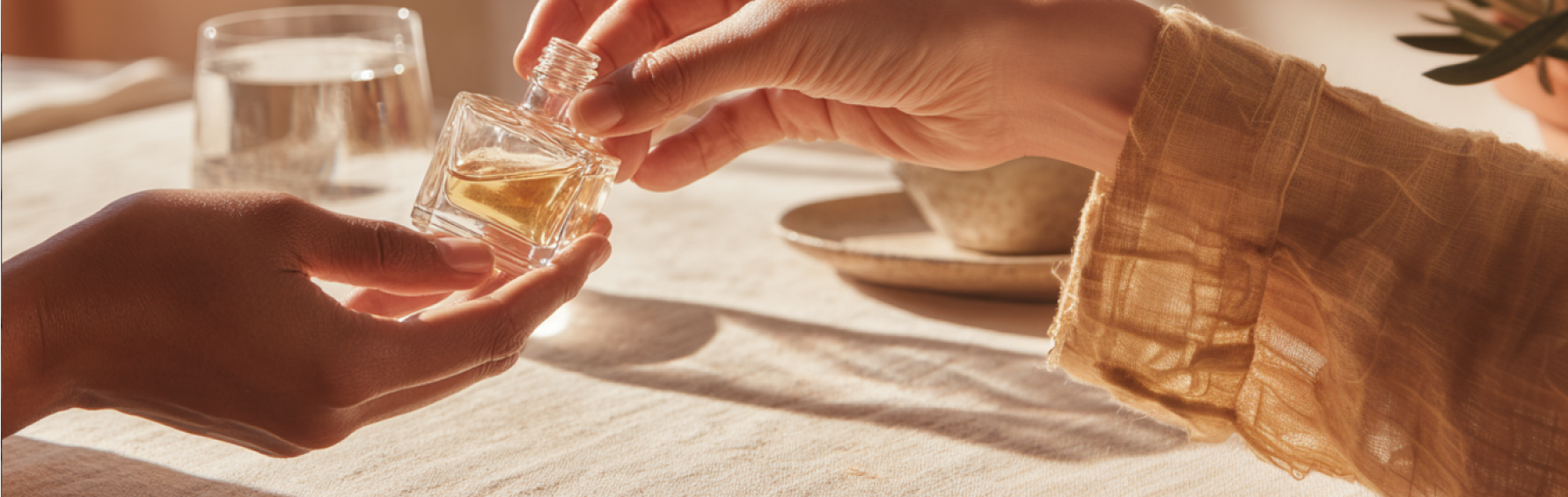
Every bottle of perfume is the end point of a long chain – a field, a still, a perfumer’s formula, a resting tank and a filling line. Very little of it happens the way people imagine, and almost none of it happens quickly.
Understanding how perfume is made explains the things that otherwise look arbitrary: why two fragrances at the same price smell worlds apart, why one lasts eight hours and another forty minutes, and why a natural material can cost more per kilo than silver. This guide follows the chain in order, from the raw material in the ground to the sealed bottle.
What perfume is actually made of
A finished perfume looks like one liquid. It is really four things held in balance, and the proportions decide almost everything about how it behaves.
| Component | Typical share | What it does |
|---|---|---|
| Fragrance concentrate | 2–30% | The blend of natural and synthetic aroma materials. This is the actual smell, and almost all of the cost. |
| Perfumer’s alcohol | 60–95% | Dissolves the oils and carries them. As it evaporates it releases the materials in sequence, which is what creates the impression of a fragrance changing over time. |
| Distilled water | 0–5% | Softens the alcohol bite in lighter concentrations. Absent from most high-concentration extraits. |
| Fixatives and stabilisers | Trace | Slow evaporation to extend wear, and protect the liquid against UV, oxidation and colour shift on the shelf. |
The concentrate itself is where the craft sits. A commercial fragrance commonly contains between forty and a hundred and fifty individual materials, each weighed to two decimal places, and a complex oriental or oudh can exceed two hundred.
Top, heart and base: how a fragrance is built
A perfume is not designed to smell the same for its whole life on skin. It is built in three layers, and they reveal themselves in order as the lighter, more volatile molecules evaporate away first.
| Layer | How long it lasts | Typical materials |
|---|---|---|
| Top notes | 5–20 minutes | Bergamot and citrus, aldehydes, light herbs, cardamom. The first impression, and the part most people buy on. |
| Heart notes | 2–4 hours | Rose, jasmine sambac, tuberose, champaca, spice. The body of the fragrance and the reason someone wears it again. |
| Base notes | 6–24 hours and beyond | Sandalwood, oudh, vetiver, amber, musk, resins. The drydown, and where quality is hardest to disguise. |
Base notes are the honest part of a fragrance. The heavy materials that anchor a composition – sandalwood, agarwood and vetiver among them – are slow to grow, slow to distil and difficult to secure at consistent quality. A thin, short, generic drydown almost always means the money went somewhere other than the formula.
How the aromatic materials are extracted
Before anything can be blended, the smell has to be separated from the thing that grew it. The method depends entirely on the material and on how much heat it will survive.
Steam distillation
Steam is passed through plant material in a still. The heat ruptures the oil-bearing cells, the aromatic molecules travel with the vapour, and the condensed liquid separates into essential oil and hydrosol. This is the workhorse of the industry – sandalwood, vetiver, rose, cardamom and most woods, roots and herbs are produced this way.
Solvent extraction, concrete to absolute
Flowers too delicate to survive heat – jasmine, tuberose, pink lotus – are washed with a food-grade solvent instead. Evaporating the solvent leaves a waxy paste called a concrete, which is then washed with alcohol and chilled to drop out the wax, yielding an absolute. It takes hundreds of kilograms of hand-picked flowers to make a single kilogram of absolute, which is why these materials cost what they do.
Cold pressing
Citrus peel is pressed mechanically, squeezing oil directly out of the rind with no heat involved at all. It is the reason cold-pressed bergamot and lemon smell so immediate and so true to the fruit.
Supercritical CO2 extraction
Carbon dioxide held between its liquid and gas states behaves as a solvent, then evaporates away completely at room temperature leaving no residue. It captures a fuller, rounder profile than distillation – noticeably closer to how the raw material actually smells in the hand.
Enfleurage
The historic method. Petals are laid on odourless fat that absorbs their scent over days, and the saturated fat is then washed with alcohol. Solvent extraction has replaced it almost entirely, but it survives artisanally for the few flowers that keep producing scent after they are picked.
Headspace capture and synthesis
Some smells cannot be extracted at all – a living orchid, sea air, rain on hot stone. A glass dome captures the air around the subject, gas chromatography identifies what is in it, and the profile is rebuilt from aroma chemicals. Synthesis also gives perfumers molecules that do not exist in nature, and sustainable substitutes for materials that are protected or endangered.
How perfume is made, step by step
Once the materials exist, the sequence from formula to filled bottle runs like this.
- Harvesting and sourcing. Flowers are picked in a specific window on a specific morning; woods are aged before they are distilled. Timing measurably changes the oil, which is why the same species from the same field yields differently year to year.
- Extraction. Raw material becomes essential oil, absolute or resinoid by whichever of the methods above suits it.
- Formulation. A perfumer writes the formula against a brief, has it weighed and compounded, smells it, and revises. A submission that wins a brief has usually been through dozens of iterations.
- Compounding. The approved formula is weighed and blended at production scale under controlled temperature, with batch records against a reference standard.
- Dilution. The concentrate is dissolved into perfumer’s alcohol at the target percentage. This single number sets the concentration grade and much of the retail price.
- Maceration and maturation. The blend rests in sealed tanks, away from light, while the materials bind and settle.
- Chilling and filtration. The liquid is cooled so waxes and particulates drop out, then filtered, so the juice stays clear and stable for its whole shelf life.
- Quality control and filling. Batches are checked against the reference, tested for stability, and cleared against IFRA restrictions for the product category before filling, crimping, capping and packing.
The same process, from a manufacturer’s side
The eight steps above are the craft. Producing a fragrance commercially adds a second layer of decisions on top of them, and our companion guide to the perfume manufacturing process covers that layer in six stages:
- Concept and brief – turning a commercial vision into technical targets a perfumer can actually formulate against.
- Formulation – designing for reproducibility and cost from the first trial, not treating manufacture as an afterthought.
- Sourcing and compounding – why owned or managed ingredient supply protects a brand from price swings and shortages.
- Maceration and maturation – the stage that gets compressed when a timeline slips, and what it costs when it does.
- Filling and assembly – fill accuracy, seal integrity and the presentation that decides perceived quality on a shelf.
- Quality control and compliance – batch-to-batch consistency, stability testing, IFRA compliance and traceability.
It also sets out what MOQ really means in fragrance, how contract manufacturing works, and the questions worth asking a manufacturer before committing to a run.
Why perfume has to rest before it is bottled
Maceration is the step most often shortened when a production run is behind schedule, and the one customers notice without ever being able to name it.
Freshly blended perfume smells sharp and disjointed. The alcohol sits on top of the oils rather than carrying them, the top notes shout, and the composition has no middle. Given days to weeks in a dark, temperature-controlled tank, the materials react and integrate. The fragrance becomes rounder, smoother, and consistent from the first spray through to the drydown.
A perfume that smells different in month three than it did in the shop was almost always under-macerated. We have written about why fragrance has to rest before you can judge it in more detail, because it is the single most misunderstood stage in production.
Parfum, EDP, EDT: what the strengths mean
The same formula can be sold at several strengths. The only difference between them is how much concentrate is dissolved in the alcohol.
| Type | Concentrate | Typical wear |
|---|---|---|
| Parfum or extrait | 20–30% | 8–12 hours |
| Eau de parfum | 15–20% | 6–8 hours |
| Eau de toilette | 5–15% | 3–5 hours |
| Eau de cologne | 2–4% | 2–3 hours |
| Eau fraîche | 1–3% | 1–2 hours |
Ranges are industry conventions, not regulated definitions. A house may label at its own discretion.
A higher concentration is not automatically a better fragrance. Lighter compositions are often designed to be worn lightly, and loading the same formula to extrait strength can make it heavy rather than luxurious. What the number reliably tells you is cost and wear time, not quality.
Naturals and synthetics, and why the mix matters
Almost every modern fragrance uses both, and that is a strength rather than a compromise.
Naturals bring a complexity no single molecule can imitate – a real rose oil contains hundreds of compounds interacting at once. Synthetics bring consistency, longevity, safety, affordability, and access to smells that cannot be harvested from anything. The skill is in the ratio, and in knowing precisely which materials are worth paying for and which are not.
The complication is that naturals are agricultural products. A poor monsoon, a crop disease or a speculative market can double an ingredient’s price or make it unavailable in the middle of a production run. This is why who controls the raw material supply matters as much as who writes the formula – a point that decides far more fragrance launches than it gets credit for.
Developing a fragrance of your own?
Sawai runs the full chain in-house – owned naturals, distillation, perfumery, compounding, filling and compliance – as private-label or white-label manufacturing.
How Sawai makes perfume
Most fragrance suppliers own one link in the chain described above and buy the rest. Sawai has spent sixty years building the whole of it, from a single hydro-distillation unit in Kannauj in 1965 to owned plantations, in-house perfumery and certified manufacturing today.
- We own the naturals at source. Around 2,000 acres of owned sandalwood plantation, together with owned fields and dedicated farmer networks. Rose, kewra, jasmine sambac and grandiflorum, tuberose, champaca, pink lotus, vetiver, agarwood, davana, sugandh mantri and cardamom are produced and managed at scale – not bought on the spot market after an order lands.
- We distil and extract ourselves. Traditional distillation expertise sits beside modern extraction technology in our own facilities, taking diverse natural materials from raw source to finished oil. Nothing critical is outsourced, so nothing critical sits outside our control.
- Our perfumers know what is in the drum. More than 1,500 fragrance creations across fine fragrance, Middle Eastern attars and oudh, naturals and air care. Because our perfumers know exactly what comes out of our own stills, they can write formulas that survive production rather than ones that only work on a blotter.
- Steadier quality, steadier pricing. Owning supply insulates our partners from the price swings, quality variation and shortages that hit spot-sourced naturals hardest. That is the practical value of backward integration: the cost sheet and the smell both stay where you left them.
- End to end, under one roof. Concept, formulation, compounding, maceration, filling, quality control and IFRA-compliant documentation, delivered as private-label or white-label manufacturing for more than 100 long-term brand partners.
The short version
- Perfume is fragrance concentrate dissolved in alcohol. The concentrate is 2–30% of the bottle and close to all of the cost.
- Aromatic materials are extracted by steam distillation, solvent extraction, cold pressing, CO2 extraction or enfleurage, or built synthetically. Almost every fragrance uses both natural and synthetic materials.
- A formula is built in three layers – top, heart and base – that reveal themselves in order as the lighter molecules evaporate first.
- Maceration is not optional. Skipping it is why some fragrances smell different a few months after purchase.
- Concentration grade sets wear time and price. It does not set quality.
- Who controls the raw materials decides whether a fragrance can be reproduced consistently and priced predictably.
Frequently asked questions
How long does it take to make a perfume?
Formulation typically runs from six weeks to six months, depending on how many revision rounds the brief needs. Compounding itself is quick, but maceration and maturation add days to several weeks before anything can be filled. A realistic end-to-end timeline for a new commercial fragrance, from brief to finished stock, is three to nine months.
How many ingredients are in one perfume?
Most commercial fragrances contain between forty and a hundred and fifty individual materials. Deliberately minimalist compositions may use fewer than twenty; complex orientals and oudh-based fragrances can exceed two hundred. Ingredient count is not a measure of quality – some of the most recognisable fragrances ever made are structurally simple.
Why are some perfumes so expensive?
Raw material cost drives most of it. Natural jasmine absolute, oudh, orris and rose oil run into thousands of dollars per kilogram because yields are tiny and growing cycles are long – it takes hundreds of kilos of hand-picked flowers to produce one kilo of absolute. Higher concentration, longer maceration and packaging account for the rest. Retail price also carries marketing and distribution, which in mass fragrance frequently exceeds the cost of the liquid several times over.
What is the difference between eau de parfum and eau de toilette?
Only the concentration of fragrance oil. An eau de parfum carries roughly 15–20% concentrate and wears for six to eight hours; an eau de toilette carries 5–15% and wears for three to five. The same formula at EDT strength also reads lighter and sharper on the opening, because the proportions of the volatile top notes shift relative to the base.
Are natural perfumes better than synthetic ones?
Neither is inherently better. Naturals bring complexity that no single molecule reproduces; synthetics bring consistency, longevity, safety and scents that cannot be harvested at all. Synthetics are also what make several endangered materials avoidable. Almost every fragrance on the market, at every price point, uses both, and the quality of a perfume comes from how well they are combined rather than from the ratio itself.
Can I create my own perfume brand without a factory?
Yes. Contract manufacturing – private label or white label – gives a brand access to formulation, production, quality control and regulatory compliance without any investment in plant. Our guides to the perfume manufacturing process and to starting a perfume business in India cover how MOQs, timelines and partner selection actually work.
Sixty years of making fragrance, end to end
From owned sandalwood plantations and in-house distillation to perfumery, compounding and compliant manufacturing – Sawai runs every stage of the process described above under one roof, for more than 100 brand partners.