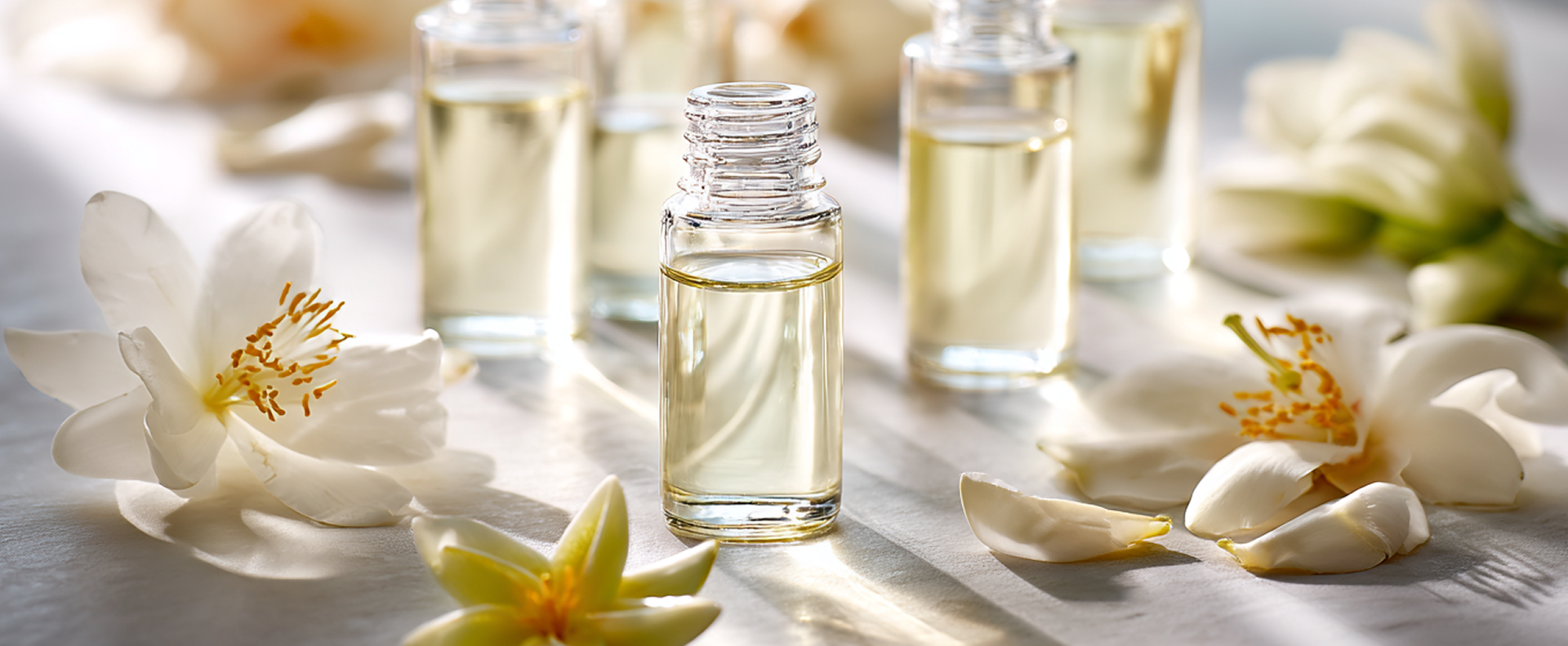
Spray a fragrance and smell it immediately, then again after an hour, and you are smelling two different things. That is not the perfume fading. It is the perfume working exactly as it was designed to.
A composition is built in layers that reveal themselves in sequence as the lighter molecules evaporate away first. Understanding that structure is the difference between choosing a fragrance from its opening – which is the part you will wear for fifteen minutes – and choosing it from what it becomes.
What a perfume note is
A note is a single identifiable scent element within a composition – bergamot, rose, sandalwood, vanilla. The word is borrowed from music deliberately, and the analogy holds: individual notes combine into chords, and chords into a structure that unfolds over time.
One thing the analogy hides is that a note is not necessarily an ingredient. A fragrance listing “fig” almost certainly contains no fig, because fig yields no usable essential oil. What it contains is a set of aroma materials assembled by a perfumer to read as fig. The note describes the impression, not the contents.
The fragrance pyramid: top, heart and base
| Layer | Lasts | Role | Typical materials |
|---|---|---|---|
| Top notes | 5–20 minutes | The first impression. Bright, immediate, and the reason a fragrance sells at a counter. | Bergamot, lemon, grapefruit, mint, aldehydes, cardamom, light green notes |
| Heart notes | 2–4 hours | The body and identity of the fragrance. What people mean when they describe how it smells. | Rose, jasmine, tuberose, champaca, geranium, cinnamon, clove, iris |
| Base notes | 6–24 hours+ | The foundation and the drydown. Also anchors the layers above by slowing their evaporation. | Sandalwood, oud, vetiver, patchouli, amber, musk, vanilla, benzoin, labdanum |
The layers are not sequential blocks. They overlap continuously – the base is present from the first second, quietly, and becomes audible only as the material above it clears. A well-built fragrance transitions without a seam. A poorly built one has an obvious gap where the heart should have carried it.
Why notes appear in order
The pyramid is not a stylistic convention. It is a consequence of physics.
Aromatic molecules differ in volatility – how readily they evaporate at skin temperature. Small, light molecules leave quickly; large, heavy ones leave slowly. Citrus molecules are gone in minutes. Sandalwood and musk molecules are still evaporating the next morning. A perfumer arranging materials into top, heart and base is arranging them by molecular weight, whether or not they are thinking about it in those terms.
This is also why fixatives matter. Heavy base materials – resins, woods, musks – physically slow the evaporation of lighter materials blended with them. A rose with no base beneath it disappears in an hour; the same rose over sandalwood and musk lasts most of a day. Longevity is engineered in the base, not bought by adding more of the flower.
This is why concentration and structure are separate things. Raising the percentage puts more of everything on the skin. Building a stronger base changes how long the fragrance holds together. A brand chasing longevity by increasing concentration alone is solving the wrong problem, expensively.
The fragrance families
Families group fragrances by their dominant character. Several competing classification systems exist and none is authoritative, but the four broad groups below are recognised almost everywhere.
| Family | Character | Common subdivisions |
|---|---|---|
| Fresh | Bright, clean, immediate. Built on citrus, green and marine materials. | Citrus, aromatic, green, aquatic |
| Floral | The largest family by a distance. Single flowers or bouquets. | Soliflore, floral bouquet, fruity floral, powdery floral |
| Amber / oriental | Warm, resinous, spiced, sweet. Dense and long-wearing. | Soft amber, spicy amber, woody amber, gourmand |
| Woody | Dry or creamy woods, often with earthy or smoky facets. | Mossy woods, dry woods, sandalwood, oud |
Almost every commercial fragrance sits between two of these rather than squarely in one, which is why descriptions like “woody amber” or “fresh floral” do more work than a single family name.
Two families deserve a specific note in an Indian and Gulf context. Amber and woody compositions dominate here in a way they do not in Europe, partly because heat amplifies projection and partly because oud, sandalwood and resins are the region’s own materials rather than imported exotica.
Accords: what a perfumer actually builds with
Perfumers do not work note by note. They work in accords – small combinations of materials that behave as a single new smell, in the way three musical notes make a chord that is heard as one thing rather than three.
A chypre accord is bergamot, labdanum and oakmoss. A fougère is lavender, coumarin and oakmoss. Neither smells like its parts. Once built, an accord becomes a building block that can be placed into a composition whole.
This is why a note list can be simultaneously accurate and unhelpful. Listing bergamot, oakmoss and labdanum tells you almost nothing; saying “a classical chypre” tells an experienced nose a great deal. The materials are the same. Only one description carries the structure.
How to read a note list critically
Published note lists are marketing documents, not formulas. They are not dishonest so much as differently purposed, and four things are worth knowing.
- The formula is confidential. No brand publishes its actual composition. A note list is a description written for consumers, usually by a marketing team.
- Named notes are often impressions, not materials. Fig, peony, lily of the valley, sea air, rain and leather all appear routinely on note lists and none yields a usable natural extract. Each is reconstructed from other materials.
- Expensive materials are named disproportionately. Oud, orris, ambergris and saffron appear on note lists far more often than the world produces them. Usually the accord is present and the material is not.
- The list is rarely in proportion. A note contributing 0.1% may be listed beside one contributing 20%, with no indication of which is which.
The reliable test is the same one perfumers use: put it on skin and wait an hour. The drydown is where materials cannot hide. A base that stays interesting, textured and defined after four hours tells you more about a formula than any list.
Briefing a fragrance in notes
For a brand commissioning a fragrance, notes are the natural vocabulary to brief in and a surprisingly unreliable one on their own.
A brief saying “rose, oud and saffron” can be interpreted a dozen legitimate ways. Which rose – Turkish, Damask, a fresh rose or a jammy one? Is the oud animalic and smoky or clean and woody? Are these equal partners or is one dominant? Perfumers submit against these ambiguities, and the resulting rounds of revision are the most common reason fragrance development runs late.
More useful briefs specify:
- Structure, not just ingredients. Which note leads, which supports, and what the fragrance should have become after four hours.
- Performance targets. Longevity, projection, and how it must behave in the destination climate.
- References. Existing fragrances as directional anchors, stated as directions rather than as things to copy.
- The constraints. Cost per kilogram, the product category and its IFRA restrictions, and the concentration. These shape the formula more than any adjective in the brief.
Sawai’s perfumers work across fine fragrance, Middle Eastern compositions, naturals and air care, with over 1,500 fragrance creations behind them – and with the advantage of knowing precisely what comes out of the company’s own stills, because the naturals are grown, distilled and processed in-house rather than bought finished.
Have a fragrance direction in mind?
From brief to bottle – formulation, compounding, quality control and compliance, under one roof.
The short version
- A note is an identifiable scent element. It describes an impression, not necessarily an ingredient.
- Top notes last 5–20 minutes, heart notes 2–4 hours, base notes 6–24 hours and beyond.
- The order is physics, not convention – light molecules evaporate first, heavy ones last.
- Base materials act as fixatives, slowing the evaporation of everything blended with them. Longevity is built there.
- Perfumers work in accords, not single notes. An accord smells like nothing its parts smell like.
- Published note lists are marketing documents. The drydown after four hours is the honest test.
Frequently asked questions
What are perfume notes?
Notes are the individual identifiable scent elements in a fragrance – bergamot, rose, sandalwood and so on – arranged into three layers that appear in sequence as the composition evaporates. A note describes an impression rather than necessarily an ingredient: a fragrance listing “fig” contains no fig, because fig yields no usable extract, but a set of materials assembled to read as fig.
What is the difference between top, heart and base notes?
Top notes are the light, volatile materials you smell first, lasting five to twenty minutes – citrus, aldehydes, light herbs. Heart notes form the body of the fragrance and last two to four hours – florals and spices. Base notes are heavy, slow-evaporating materials such as sandalwood, oud, amber and musk, lasting six to twenty-four hours or longer, and they also anchor the layers above by slowing their evaporation.
Why does my perfume smell different after an hour?
Because it is designed to. The lightest molecules evaporate first, so the bright opening clears within about twenty minutes and reveals the heart underneath, which in turn gives way to the base. Nothing has gone wrong – you are smelling the structure unfold. It is why judging a fragrance from the first spray tells you about fifteen minutes of a day-long experience.
What is a fragrance accord?
An accord is a small combination of materials that behaves as a single new smell, the way several musical notes form a chord heard as one thing. A chypre accord is bergamot, labdanum and oakmoss; a fougère is lavender, coumarin and oakmoss. Neither smells like its components. Perfumers compose with accords as building blocks rather than working material by material.
Do perfumes actually contain the notes listed on them?
Often not, and not because brands are being dishonest. Many listed notes – fig, peony, lily of the valley, sea air, leather – cannot be extracted from nature at all and are reconstructed from other materials. Note lists are consumer descriptions rather than formulas, they are not published in proportion, and expensive materials such as oud and orris are named far more often than the world actually produces them.
Which notes last the longest?
Base notes, because their molecules are large and heavy and evaporate slowly – sandalwood, oud, vetiver, patchouli, amber, musks, vanilla and resins such as benzoin and labdanum. These also act as fixatives, holding lighter materials on the skin far longer than they would last alone. A fragrance built on citrus and florals with no substantial base will not last regardless of its concentration.
1,500 fragrances, and counting
Sawai’s perfumers compose across fine fragrance, Middle Eastern fragrance, naturals and air care – working with materials grown, distilled and processed by the company itself, for more than 100 brand partners over sixty years.