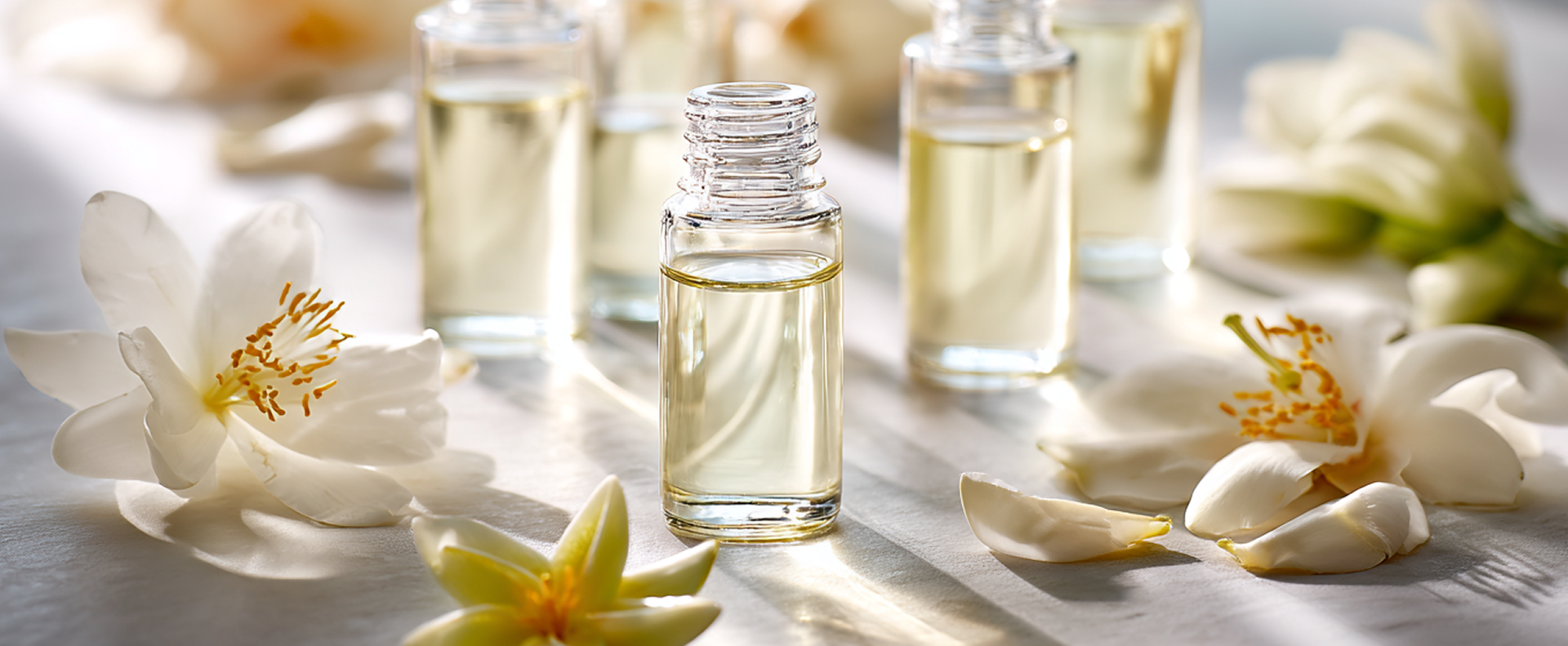
CO₂ extraction has changed what naturals can smell like. Oils extracted this way are often closer to the living plant than anything distillation can produce, with no solvent residue and less heat damage. Here is how the process works, and when it is worth the extra cost.
What is supercritical CO₂ extraction?
Supercritical CO₂ extraction uses carbon dioxide under high pressure and moderate temperature, above about 31°C and 74 bar, where it behaves like both a gas and a liquid. In this “supercritical” state, CO₂ dissolves aromatic compounds from plant material. When the pressure is released, the CO₂ returns to a gas and leaves behind a solvent-free extract.
The same technology is used to decaffeinate coffee. In perfumery and aromatherapy, it produces extracts that are often richer and truer to the raw material than steam-distilled oils.
How the process works
- Preparation: the botanical is dried and ground to the right particle size.
- Extraction: CO₂ is pressurised and gently heated until supercritical, then passed through the plant material in an extraction vessel.
- Separation: the CO₂, now carrying the dissolved aromatic compounds, moves to a separator where pressure is lowered. The CO₂ turns back to gas and the extract drops out.
- Recycling: the CO₂ is recompressed and reused in a closed loop.
By adjusting pressure and temperature, the operator can tune which compounds are extracted. That control is the real power of the method.
Select vs total CO₂ extracts
- Select extracts are made at lower pressure. They contain mainly the volatile aromatic compounds and are fluid, closer to an essential oil.
- Total extracts are made at higher pressure. They also pull heavier compounds like waxes, fats and pigments, and can be thick or semi-solid, giving a fuller, more complete profile.
CO₂ extraction vs steam distillation
| Supercritical CO₂ | Steam distillation | |
|---|---|---|
| Temperature | Low (around 35–60°C) | Around 100°C |
| Scent | Closer to the fresh plant, fuller | Can lose or alter delicate notes |
| Compounds captured | Wider range, including heavier molecules | Mainly volatile, water-insoluble molecules |
| Residue | No solvent residue | None (water only) |
| Equipment cost | High | Lower |
| Price of the oil | Usually higher | Usually lower |
A good example is ginger. Steam-distilled ginger oil is fresh and lemony, but it lacks the hot, spicy bite of the root. A CO₂ extract captures the pungent compounds too, so it smells much more like freshly cut ginger.
Advantages and limitations
Advantages
- Low heat preserves delicate and heat-sensitive compounds
- No solvent residue, and CO₂ is non-toxic and recycled
- Highly tunable to target specific compounds
- Often higher yields for certain materials
Limitations
- Expensive equipment and higher operating costs
- Not every material benefits enough to justify the cost
- Total extracts can be thick and harder to formulate with
Which botanicals benefit most
CO₂ extraction shines with roots, rhizomes, seeds, spices and resinous botanicals, where distillation misses heavier or heat-sensitive compounds. At our Nilakkottai facility we process materials such as nagarmotha, vetiver, geranium, palmarosa and other aromatic botanicals using supercritical CO₂ (SCFE).
Looking for CO₂ extracts or high-value naturals?
Frequently asked questions
Is CO₂ extraction better than steam distillation?
For many roots, spices and heat-sensitive botanicals, CO₂ gives a fuller, truer extract. For many leaves and grasses, steam distillation gives an excellent oil at a lower cost. It depends on the material and the use.
Are CO₂ extracts safe?
Yes. CO₂ is non-toxic and leaves no residue once the pressure is released. As with any natural extract, use levels should follow IFRA Standards for the product type.
Is a CO₂ extract an essential oil?
Strictly speaking, no. “Essential oil” refers to oils obtained by distillation or expression. CO₂ extracts are a separate category, though select extracts are often used in similar ways.
Why are CO₂ extracts more expensive?
The high-pressure equipment is costly to build and run, and the process is often applied to premium raw materials.
Does Sawai supply CO₂ extracts?
Yes. Our Nilakkottai facility runs solvent and supercritical CO₂ extraction for high-value botanicals. Get in touch to discuss your requirements.
Advanced extraction, from our own facility
Sawai’s Nilakkottai facility uses supercritical CO₂ and solvent extraction to produce clean, stable naturals for perfumery and personal care.